The re-accreditation of higher education institutions is one of the key procedures for quality assurance of higher education in the Republic of Croatia. Pursuant to the Act on Quality Assurance in Higher Education and Science (OG 151/22), the Agency for Science and Higher Education conducts the procedure of re-accreditation of higher education institutions.
All higher education institutions, both public and private, are required to undergo this process every five years in order to assess their quality in accordance with national legal criteria, as well as the Standards and Guidelines for Quality Assurance in the European Higher Education Area (ESG). The purpose of the re-accreditation process is to continuously monitor and improve the quality of the work of higher education institutions. In this way, students are provided with an educational environment that meets high standards.
One of the key elements of the re-accreditation process is the self-evaluation report, which is prepared by the higher education institution prior to the visit of the expert panel. The self-evaluation report serves as the basis for further implementation of the re-accreditation process and for making a decision on its final outcome (the decision to issue a licence). The self-evaluation report contains data grouped into five assessment areas covering aspects of the higher education institution’s activities, such as:
- Higher education institution management and quality assurance,
- Study programmes and lifelong learning programmes,
- Student-centred learning and teaching – teaching process and student support,
- Teaching capacities and infrastructure of the higher education institution,
- Research/artistic and professional activity.
An important part of the self-evaluation report is the analytical supplement, which contains tables presenting specific data on the higher education institution both qualitatively and quantitatively. These tables contain data on the higher education institution, its study programmes, students and teaching staff, infrastructure, as well as its scientific and research activities, presented in a format specifically designed for the re-accreditation process.
For many years, the Mozvag information system has been used to prepare the analytical supplement. Its first version was developed back in late 2004, during the implementation of the Bologna reform. In the meantime, Mozvag has undergone a major adaptation to legislative changes and has been integrated with the Information System of Higher Education Institutions (ISVU) and the Croatian Scientific Bibliography (CROSBI) in order to facilitate the preparation of the complex data required for the preparation of the analytical supplement.
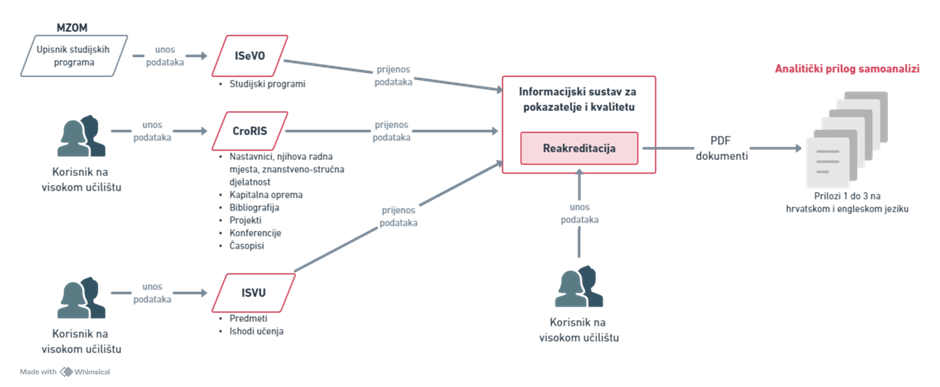
When Mozvag no longer met the requirements, ASHE and Srce jointly analysed both the existing and emerging national information systems for higher education and science and designed a process to guide higher education institutions through the preparation of the analytical supplement, thereby significantly easing this challenging task. In doing so, the existing information systems were identified as useful and important data sources. These include CroRIS, ISVU, ISeVO, and the Register of Study Programmes.
At the beginning of 2025, Mozvag was replaced by the new Information System for Indicators and Quality (ISPIK) and its Re-accreditation module. Since then, the ISPIK system has been used in the third cycle of re-accreditation of higher education institutions.
The analytical supplement template is available on the webpage dedicated to the re-accreditation of higher education institutions:
The position of the new information system in relation to the existing interconnected information systems, as well as the entry of data required for the analytical supplement to the self-evaluation report, is illustrated in the figure below.